I don't have a scanned copy of the cover of this book because I bought it as an e-book on the Taunton website. If you wait for a sale, you can purchase this e-book for half off.
Title: Easy Guide to Sewing Tops & T-Shirts
Author: Marcy Tilton
ISBN: 1561582395
Publication Date: 1998
Pages: 128
Overall impression, I like this book and would recommend it to others. I consider this book a must have if you want to take your sewing to the next level. If you want quick and easy, this may not be required reading. Many of her suggestions for getting the most out of your fabric or pattern design will add to your construction time. I learned quite a bit and most of the book is very detailed. There were a few instances where I found Marcy's description of a technique a bit inadequate (for my understanding anyway, you may think she was very clear). There are more photos than drawings but I wish there was an illustration for each step when she is explaining a technique. Usually there are only 2 or 3 photos for a 7-step process and sometimes I found myself scratching my head wondering how she got from picture 2 to picture 3. She does a great job giving you ideas on how to venture away from the basic pattern construction, such as manipulating a fabric to showcase it's best properties. I particularly enjoyed the section on changing on-grain patterns to a bias grain. She goes into great detail about which fabrics are best for bias work and how the pattern will need to be modified. For those of you thinking "Why bother?", read the book. Her description helps you realize that you don't need to purchase a new pattern for each design detail you like. Have a handful of patterns you've used in the past quite successfully. Now put a spin on the design, add an interesting neck binding, cut the fabric on the bias, embellish the fabric, and now your tried-and-true pattern looks like a completely different top.
The construction chapters are broken down by woven vs. knit top construction, which is very helpful. She starts the discussion with a list of steps and then goes into great detail on the following pages. She gives recommendations for fabrics for those just starting out. For instance, silks are lovely to wear but not a beginner fabric. Rayons, although nice to touch, are more difficult to manipulate on the bias so save those for when you are more experienced.
Marcy talks a lot about "staystitch-plus" (or easestitch-plus) as a method of easing a longer section of fabric to match a shorter section of fabric as you sew. I had never heard of this term before so I had to read the description of this several times. (I found a decent description of it here in regards to hems--scroll one-third of the way down the page.) I can see how this would be a great way to set-in sleeves and such. I find the technique confusing regarding topstitching (and Marcy recommends using it in topstitching quite a bit). Wouldn't that give you bumpy topstitching? With natural fibers, you could probably steam out the bumps and give it a nice look but I still don't understand why you would want to ease a hem's topstitching. Ease the hem's raw edge before pressing the hem and topstitching, that I get but easing the topstitching?? Maybe that is what Marcy meant but I've re-read that section several times (and she mentions it elsewhere and I've re-read those as well) and it just doesn't sound right to me. If you follow the link I gave above (link here), you'll see this author specifically says not to staystitch-plus a hem's topstitching, as in a turn-and-stitch hem. Anyway, I haven't tried to use this technique on a hem yet so take my opinion with a grain of salt.
One technique I do disagree with (and have ample experience with) is Marcy's recommendation to not use double-needle stitching on hems for double knits. I have done this successfully with every double knit I've used (mostly poly blends or rayon) and I've never had any stretching or rippling that she warns will happen. (Perhaps a silk double knit would ripple with the double-needle topstitching.) I have, however, had skipped stitches and thanks to her recommendations for needles when sewing knits, I now know why. She does a fantastic job explaining how to add a strip of interfacing to a hem. I thought you fused the interfacing to the hem allowance, pressed up the hem and then stitched. She recommends stitching the interfacing to the hem first (interfacing is fusible side up, so nonsticky side is stitched to wrong side of fabric), press up the hem (which fuses the interfacing to secure the hem), flip to the right side of the fabric and topstitch. With the hem already fused in place, no slippage while you sew. So simple but very handy.
Marcy's section on use of the bias grain is fantastic as well. She even shows you how to use the bias (with center seam) on a sleeve to make an interesting effect with a striped fabric. It is stunning and I will have to try that some time soon. My only quibble with this section of the book is the recommendation to stretch the fabric as you sew a bias seam. She says you stretch the fabric as much as possible while you stitch and then steam it flat. I've not had luck with this in the past but perhaps I was being too gentle with my fabric. I took a couture sewing class with Susan Khalje last summer and she showed us a great way to sew bias seams stitched in short segments (described very clearly in each of her books). This method doesn't sound like it would work but one of the ladies in the class was sewing silk with bias seams and it looked great. I've never seen a bias seam look so good before. It hung beautifully, not a ripple in sight. I will have to compare these 2 techniques and see which I like better.
The best section of this book is the "pattern proofing" section. She spends an entire chapter talking about little tweaks to make to your pattern before you cut your fabric. Adding a little extra width and length at the bust area for large busts. Curving the shoulder and sleeve hems to hang nicely. Those are just a few but they make sense because fabric drapes and your body isn't flat like pattern paper. These little tweaks help take a flat pattern to a wearable garment that works with the body's contours instead of against it. I probably spent the most time reading this one chapter alone.
This book was a great read, and even a fast read because it was so enjoyable to read. Even though I disagree with a few of the recommendations, I found the majority of her recommendations to be very helpful. The nice thing about sewing is the fact that there is usually more than one way to accomplish a task. You find what works best for you and use that, even if other experts say that technique won't give you the best results.
Wednesday, June 15, 2011


Sunday, June 12, 2011
We deserve better
We meaning you and I and every other person that has amassed a large collection of books and DVDs, spent hours on the internet reading tutorials, and spent hundreds of dollars for just a single class all in the name of improving our sewing skills. We deserve better. Our skills and years of experience are worth more than just minimum wage. I'm referring of course to the practice of charging very little for sewing lessons or those that are paid peanuts to teach sewing classes at retail stores. We deserve better.
I am still unemployed and it makes me a little crazy and a little desperate. To maintain my sanity, I decided to start teaching some sewing classes. I love sewing and figured this would be a great way to earn a little extra money and keep me out of trouble while I look for a decent job. Instead, I've put myself in a very uncomfortable situation and I've got a massive headache. I applied for an independent contractor position with JoAnn Fabrics. Independent contractors aren't paid by the store. The store collects the fees for the sewing classes, maintains a classroom and equipment, and coordinates the registrations for you. You make a sample and teach the class. JoAnn supplies the pattern but you supply the fabric and notions. (You do get to keep the sample, you can make it in your size and you can use whatever fabric you like.) JoAnn's gets 40% of the class fee and you get 60%. I admit 40% is rather high for the store but I decided it was still worth my time if at least 5 people signed up for the class. Besides, JoAnn is supplying the machines, irons, ironing board, etc. (per the Education Coordinator). Each month the store hosts an open house to introduce the instructors to the customers. The instructors don't get paid for this time but they did give me two "20% off your entire purchase coupons." Hmm, coupons only have value if you buy something to use the coupon on.
I showed up for the first open house yesterday and when I walked through the door, I saw the "50% off select classes" sign. I asked the Education Coordinator, "does that include my classes?" Well of course it does and now I only get 60% of the 50% the customer paid for the class. So let's do some math:
$55/class, 4 hours total class time = $13.75/hour
Customer paid for the class at an Open House so hourly rate is now $6.88.
Per hour: JoAnn's share is $2.75 and mine is $4.13
According to the other instructors, usually only 2-3 people sign up for a class.
My hourly rate for 2-3 people is $8.26-$12.39
I must pay the self-employment tax quarterly, which is reduced for 2011 only: 10.4% Social Security and 2.9% Medicare. I must pay the federal taxes annually--depends on your total annual income so I'll leave this out of the equation.
Hourly rate for 2-3 people (after taxes): $7.16 - $10.74/hour
Factor in costs of fabric, notions, and gas to/from store.
This can vary by project but I'll use my cheapest sample as a guide.
Extra costs:
2 yards of knit fabric from stash: $4.00/yard x 2 yards plus sales tax = $8.74
1 yard of 3.25-inch lace trim I had to purchase to make the shirt the way JoAnn's wanted it: $3.99/yard x 10% American Sewing Guild discount plus sales tax = $3.92
Small spool of thread from stash: $1.33 plus tax = $1.45
Gas to travel to store for 2 class sessions and the unpaid Open House = 3.5 miles one-way x 3 round trips x $4.00/gallon with 22 mpg = $3.82
Total extra costs: $17.93
Hourly rate after taxes and extra costs = $2.68 - $6.26/hour
(FYI...U.S. minimum wage is currently $7.25/hour.)
I forgot the best part. JoAnn's has sewing machines but requests that customers use their own. They supply ONE iron and a crappy desktop half-size ironing board. Classes are only conducted during normal store hours so it really doesn't cost the store anything but the credit card charges for accepting customer payments. For all this, they get 40%. I bust my hump to meet all their demands, including not getting paid for any JoAnn employees that wish to take my class, and I get get a whopping $2.68-6.26/hour! Some may call me a snob but I've spent years reading books, watching DVDs, taking classes, learning wherever and whenever I can. My time is worth more than $6.26 per hour. I may not be certified or hold a fashion design degree, but my skill set is hardly minimum and therefore worth more than minimum pay.
Now some of you are probably saying, "It serves her right. She should have asked questions." I did ask questions. I asked lots of questions. I was told half-truths. I feel that the Education Coordinator deceived me by leaving out crucial details, such as "your classes are offered half off once a month, which means you get only half the pay we promised you," or "we don't really supply machines and your ironing board is barely bigger than a postage stamp."
Needless to say, I'm headed to JoAnn's today to tell them to take a hike. This lousy deal isn't store policy either; it's a corporate policy. I'm so disgusted that I am seriously considering never shopping at JoAnn's again. I don't buy fabric there anyway. I just shop the pattern and notion sales. I'd rather give that money to someone else. Someone who isn't trying to screw the little guy.
So in conclusion, next time someone says they'll pay you to teach a sewing class, consider your skills, experience, and added costs before you agree to it. Chances are they are receiving a much better deal than you are. Your skills are worth something and if you don't insist on proper compensation, the person receiving your services won't place any real value on your services. You are worth more.
--Julie
I am still unemployed and it makes me a little crazy and a little desperate. To maintain my sanity, I decided to start teaching some sewing classes. I love sewing and figured this would be a great way to earn a little extra money and keep me out of trouble while I look for a decent job. Instead, I've put myself in a very uncomfortable situation and I've got a massive headache. I applied for an independent contractor position with JoAnn Fabrics. Independent contractors aren't paid by the store. The store collects the fees for the sewing classes, maintains a classroom and equipment, and coordinates the registrations for you. You make a sample and teach the class. JoAnn supplies the pattern but you supply the fabric and notions. (You do get to keep the sample, you can make it in your size and you can use whatever fabric you like.) JoAnn's gets 40% of the class fee and you get 60%. I admit 40% is rather high for the store but I decided it was still worth my time if at least 5 people signed up for the class. Besides, JoAnn is supplying the machines, irons, ironing board, etc. (per the Education Coordinator). Each month the store hosts an open house to introduce the instructors to the customers. The instructors don't get paid for this time but they did give me two "20% off your entire purchase coupons." Hmm, coupons only have value if you buy something to use the coupon on.
I showed up for the first open house yesterday and when I walked through the door, I saw the "50% off select classes" sign. I asked the Education Coordinator, "does that include my classes?" Well of course it does and now I only get 60% of the 50% the customer paid for the class. So let's do some math:
$55/class, 4 hours total class time = $13.75/hour
Customer paid for the class at an Open House so hourly rate is now $6.88.
Per hour: JoAnn's share is $2.75 and mine is $4.13
According to the other instructors, usually only 2-3 people sign up for a class.
My hourly rate for 2-3 people is $8.26-$12.39
I must pay the self-employment tax quarterly, which is reduced for 2011 only: 10.4% Social Security and 2.9% Medicare. I must pay the federal taxes annually--depends on your total annual income so I'll leave this out of the equation.
Hourly rate for 2-3 people (after taxes): $7.16 - $10.74/hour
Factor in costs of fabric, notions, and gas to/from store.
This can vary by project but I'll use my cheapest sample as a guide.
Extra costs:
2 yards of knit fabric from stash: $4.00/yard x 2 yards plus sales tax = $8.74
1 yard of 3.25-inch lace trim I had to purchase to make the shirt the way JoAnn's wanted it: $3.99/yard x 10% American Sewing Guild discount plus sales tax = $3.92
Small spool of thread from stash: $1.33 plus tax = $1.45
Gas to travel to store for 2 class sessions and the unpaid Open House = 3.5 miles one-way x 3 round trips x $4.00/gallon with 22 mpg = $3.82
Total extra costs: $17.93
Hourly rate after taxes and extra costs = $2.68 - $6.26/hour
(FYI...U.S. minimum wage is currently $7.25/hour.)
I forgot the best part. JoAnn's has sewing machines but requests that customers use their own. They supply ONE iron and a crappy desktop half-size ironing board. Classes are only conducted during normal store hours so it really doesn't cost the store anything but the credit card charges for accepting customer payments. For all this, they get 40%. I bust my hump to meet all their demands, including not getting paid for any JoAnn employees that wish to take my class, and I get get a whopping $2.68-6.26/hour! Some may call me a snob but I've spent years reading books, watching DVDs, taking classes, learning wherever and whenever I can. My time is worth more than $6.26 per hour. I may not be certified or hold a fashion design degree, but my skill set is hardly minimum and therefore worth more than minimum pay.
Now some of you are probably saying, "It serves her right. She should have asked questions." I did ask questions. I asked lots of questions. I was told half-truths. I feel that the Education Coordinator deceived me by leaving out crucial details, such as "your classes are offered half off once a month, which means you get only half the pay we promised you," or "we don't really supply machines and your ironing board is barely bigger than a postage stamp."
Needless to say, I'm headed to JoAnn's today to tell them to take a hike. This lousy deal isn't store policy either; it's a corporate policy. I'm so disgusted that I am seriously considering never shopping at JoAnn's again. I don't buy fabric there anyway. I just shop the pattern and notion sales. I'd rather give that money to someone else. Someone who isn't trying to screw the little guy.
So in conclusion, next time someone says they'll pay you to teach a sewing class, consider your skills, experience, and added costs before you agree to it. Chances are they are receiving a much better deal than you are. Your skills are worth something and if you don't insist on proper compensation, the person receiving your services won't place any real value on your services. You are worth more.
--Julie
Saturday, June 4, 2011
I have them all!!
I now own all of the Claire Shaeffer Custom Couture patterns for Vogue...I think. I have searched underneath every rock I could find and I believe my collection is now complete. Of course, this is more than a collection. I intend to make each one of these patterns (even if I think the garment is ugly) so I can practice couture sewing techniques.
The final patterns to complete the collection are:
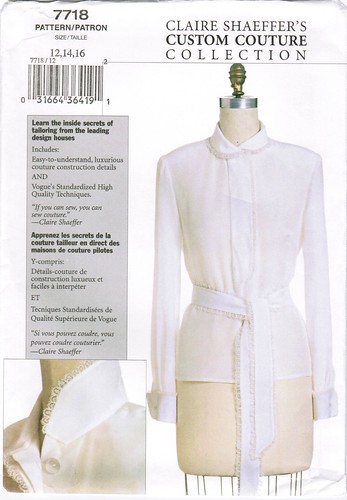
Vogue 7718
This pattern is rated for average difficulty and it was printed in 2003. Not exactly a top I would wear but maybe a different fabric could make it more modern-looking.
Vogue 8732
This is the latest edition to the collection; printed in 2011 and is rated average for difficulty. What girl couldn't use a jacket like this?

Vogue 7658
This is your basic mock wrap dress but the design is in the details. This pattern is rated average for difficulty and was printed in 2002.

Vogue 7634
Printed in 2002, this is the purple velvet coat that many have drooled over. Heck, I might even make it in purple! This pattern was printed in 2002 and is rated average for difficulty.

The most difficult patterns to find (in my size anyway) were #7634, #7658, and #7718. Every other pattern is readily available on eBay or for sale in a sewing forum somewhere. I stumbled upon these 3 patterns in a Yahoo group for selling sewing-related items. I ran a quick search for Claire Shaeffer items and found a very old post advertising these 3 patterns for $5.00 each. (Yes, I know. I basically stole them.) I contacted the seller and she still had these patterns more than a year later. In less than a week, my search was finally over.
So which pattern from the entire collection is my favorite?
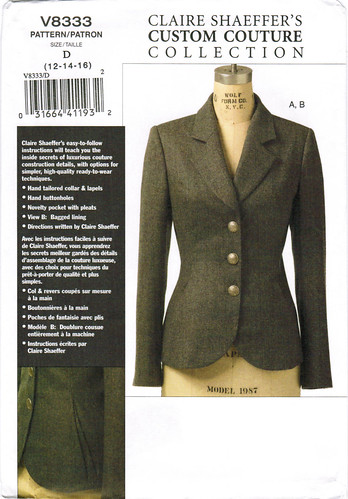
It has to be #8333. That was my first purchase and what prompted me to buy the whole collection. I love a smartly tailored jacket and the pocket detail is so great.
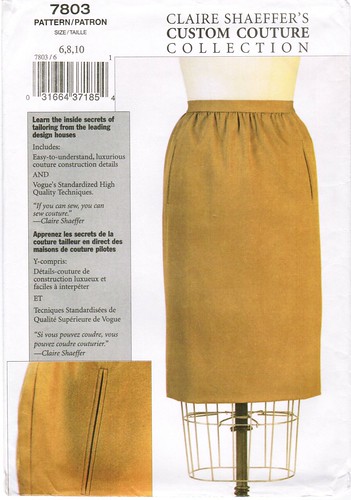
My least favorite has to be the skirt. I hate the color but once I put that aside, my eyes are immediately drawn to the gathers at the waistband. Not sleek and modern at all but maybe the gathers will hide my belly. (Or maybe I should just stop eating so much Mint Oreo ice cream. YUM!)
Vogue 7803
This pattern is rated average for difficulty and was printed in 2003. Oh, yeah. And the color is awful.
On a side note, some people have asked why I haven't been posting. Honestly, I'm flattered that anyone is reading this often enough to notice that I'm slacking at blogging. I've had many balls in the air. Some are things I want to do and some are things I have to do. Like find a job, for instance--don't want to do it. This economy is just awful. I was blind to how bad it was when I was employed. DH and I had been paying down debt and building up savings for quite some time so I was sheltered from the impact of a bad economy. Now that I don't have a job, my bank account balances have been on my mind daily. I've decided to take matters into my own hands. I've applied for at least 50 jobs...seriously. I've had 3 interviews. I'm fed up with trying to make others see my worth, my value as a potential employee. What's worse is I haven't enjoyed my work for the last 4-5 years anyway. I've contemplated starting my own sewing business for several years now. I'm finally putting this plan into action. It will be in baby steps but I feel a sense of relief knowing that one day in the forseeable future, I don't have to answer to anyone but myself AND I will love my job. An added bonus, my husband is proud of me for following my dreams. He's a keeper!
So that's what I've been up to lately. I spent yesterday refolding and organizing my entire fabric stash. I know, it's a little obsessive-compulsive but it gets the creative juices flowing. I have 2 very large piles of fabric prepped for cutting and projects picked out for all of them (mostly totes, clutches, knit tops, and pajamas). Next up is pattern alterations and cutting out the fabric. I'm in my happy place right now.
May your happy place be in your sewing room (without interruption from pets and husbands)!
--Julie
The final patterns to complete the collection are:
Vogue 7718
This pattern is rated for average difficulty and it was printed in 2003. Not exactly a top I would wear but maybe a different fabric could make it more modern-looking.
Vogue 8732
This is the latest edition to the collection; printed in 2011 and is rated average for difficulty. What girl couldn't use a jacket like this?
Vogue 7658
This is your basic mock wrap dress but the design is in the details. This pattern is rated average for difficulty and was printed in 2002.
Vogue 7634
Printed in 2002, this is the purple velvet coat that many have drooled over. Heck, I might even make it in purple! This pattern was printed in 2002 and is rated average for difficulty.
The most difficult patterns to find (in my size anyway) were #7634, #7658, and #7718. Every other pattern is readily available on eBay or for sale in a sewing forum somewhere. I stumbled upon these 3 patterns in a Yahoo group for selling sewing-related items. I ran a quick search for Claire Shaeffer items and found a very old post advertising these 3 patterns for $5.00 each. (Yes, I know. I basically stole them.) I contacted the seller and she still had these patterns more than a year later. In less than a week, my search was finally over.
So which pattern from the entire collection is my favorite?
It has to be #8333. That was my first purchase and what prompted me to buy the whole collection. I love a smartly tailored jacket and the pocket detail is so great.
My least favorite has to be the skirt. I hate the color but once I put that aside, my eyes are immediately drawn to the gathers at the waistband. Not sleek and modern at all but maybe the gathers will hide my belly. (Or maybe I should just stop eating so much Mint Oreo ice cream. YUM!)
Vogue 7803
This pattern is rated average for difficulty and was printed in 2003. Oh, yeah. And the color is awful.
On a side note, some people have asked why I haven't been posting. Honestly, I'm flattered that anyone is reading this often enough to notice that I'm slacking at blogging. I've had many balls in the air. Some are things I want to do and some are things I have to do. Like find a job, for instance--don't want to do it. This economy is just awful. I was blind to how bad it was when I was employed. DH and I had been paying down debt and building up savings for quite some time so I was sheltered from the impact of a bad economy. Now that I don't have a job, my bank account balances have been on my mind daily. I've decided to take matters into my own hands. I've applied for at least 50 jobs...seriously. I've had 3 interviews. I'm fed up with trying to make others see my worth, my value as a potential employee. What's worse is I haven't enjoyed my work for the last 4-5 years anyway. I've contemplated starting my own sewing business for several years now. I'm finally putting this plan into action. It will be in baby steps but I feel a sense of relief knowing that one day in the forseeable future, I don't have to answer to anyone but myself AND I will love my job. An added bonus, my husband is proud of me for following my dreams. He's a keeper!
So that's what I've been up to lately. I spent yesterday refolding and organizing my entire fabric stash. I know, it's a little obsessive-compulsive but it gets the creative juices flowing. I have 2 very large piles of fabric prepped for cutting and projects picked out for all of them (mostly totes, clutches, knit tops, and pajamas). Next up is pattern alterations and cutting out the fabric. I'm in my happy place right now.
May your happy place be in your sewing room (without interruption from pets and husbands)!
--Julie
Subscribe to:
Posts (Atom)