Sunday, April 24, 2011

Sewing groups

Do you belong to one?  I always shunned these before.  I figured they were full of women talking about kids and quilts.  Neither of which interested me.  Now I'm the president of the local chapter of the American Sewing Guild.  Clearly I've changed my opinion about sewing groups.  What did it?  Well, maturity for one.  I'm in my 30's now and find myself much more open to trying new things without making assumptions first.

Probably the most significant event that changed my mind...I signed up for a week-long sewing class.  Some of you may remember my Nashville Chanel and wrecked car, that is the very week I am referring to.  The class consisted of 10 women, all but one of them older than me.  We had very different backgrounds...pilot, court reporter, nurse, small business owner, fashion design instructor, etc.  We all had very different skill levels and goals for the class...make a bias skirt that doesn't have wonky seams, design a complex dress from scratch, make a date-night dress for evenings with the hubby, and for me, just learn something new.  I didn't even have a project of my own to do.  I asked a friend if I could make one of her Victorian dresses for her because I wanted a complex project that would allow me to learn the most.  If you've read this blog in the past, you know that dress never materialized but I did start a classic French jacket that makes me feel like a talented seamstress and smart, successful woman.  Not too shabby for not having a clear goal upfront. 

I was nervous about signing up for this class.  I have solid basic skills but hadn't sewn much over the last 10 years.  I figured a $1,000-class would bring in experienced seamstresses with expensive machines.  I own 2 basic Singer machines: $150 mechanical one purchased at Target and my $400 commercial machine with a jet engine. No Bernina, Janome, Viking or Pfaff for me.  When I showed up, I realized I did have the cheapest, least jazzy machine there.  I also had the loudest machine.  I was self-conscious at first but quickly realized no one cared.  They even came by to look at my machine and learn about its features.  Surely something that loud was interesting as well.

Over the course of the week I discovered I didn't feel nervous or out of place at all.  I belonged right where I was at that moment.  These ladies were fun, interesting and supportive.  We each had very different styles but somehow found each other's project beautiful and wanted to learn more.  Maybe we bonded over the fact that we each spent a buttload of money to be there.  I think we bonded more so because we shared a common interest:  wanting to improve our sewing skills and learn from others.

I've missed that group of women since the class ended.  I also realized that I can prep, cut and sew much faster than I ever have.  I'd like to believe the comaraderie got the creative juices flowing to the point that I didn't stop to doubt myself or think too much about the next step.  Just do it.

The point of this long-winded rambling is I decided before moving from Memphis to Chattanooga that I wanted to join a sewing group. I was going to put aside the idea that all sewing groups are a bunch of older ladies making quilts and talking about kids.  Problem was that Chattanooga didn't have a formal sewing group that I could find; no BurdaStyle Club, no American Sewing Guild (ASG) chapter, nothing.  (I have since learned, now that I live here, that there are a few sewing groups around but they aren't that easy to find.)  By contacting the ASG chapters surrounding Chattanooga, I found a few locals that were also interested in forming a chapter.  So now I'm the president of the Chattanooga chapter of the ASG, go figure.  And most of the ladies I've met are old enough to be my mother, and they talk about their kids, and they all quilt.  And I love spending time with them.  I even want to learn to quilt.  They want to learn to make clothes.  We inspire one another.  Isn't that what sewing groups are really all about? 

As the president of the local ASG chapter I extend an invitation to all those that sew.  Young or old, beginner or advanced, those with fancy tools and those that bought their gadgets in the same store they bought toilet paper and apple juice.  No matter if you only sew clothes, quilts, or slipcovers.  All are invited because your companionship warms my heart.  I want to know what you know.  I want to see what you've made.  You inspire me.  I hope that I can inspire you as well.

The Chattanooga chapter of the American Sewing Guild will be meeting the 3rd Tuesday of every month (except in June) at 6:30 pm at St. John United Methodist Church (3921 Murray Hills Drive).  


Our upcoming meetings are:
  • May 17--Meet & Greet, Show & Tell (bring your current projects, UFOs, favorite fabric/book/notion, anything to share)
  • June 14 (2nd Tuesday)--Paper Piecing demonstration
Contact me for more details: julstech at gmail dot com

Saturday, April 23, 2011

A pathetic follow-up

It has been 13 days so time for an update.
  • How many hours per day/week do you sew?
None since April 10th.  Now if you count anything sewing-related, I spend time "sewing" every day.  I either read, plan or organize.  Like I said in my previous post on this topic, I am a "thinker" so I don't spend a lot of time "doing."
  • What are you spending/wasting the rest of your free time on?
Applying for jobs and actually going on job interviews.  I will forgive myself a little bit since getting a job is definitely more important than sewing (how else will I afford more fabric?).  I spent yesterday afternoon tidying up my sewing space.  I consider that productive as the mess was stifling any creativity I had.  Oh, and I've been reading about sewing. I started drafting my moulage a la Kenneth King.
  • When you do sew, how do you feel before, during and afterwards?
No sewing equals nothing new to add here.
  • What factors are you aware of that impact upon when you make time to sew?
Mostly my mood.  I'm a little down in the dumps right now; being unemployed does that to you.  Making time to sew (rather, work on sewing-related stuff) does help improve my mood though.  Seems like a no-brainer (sewing=improved mood) but motivation is lacking some times.
    • What are you learning about sewing productivity from this process, if anything? What tips can you share?
    Just do it. Even if you only have 30 minutes, do something to move your projects along.

    Sunday, April 10, 2011

    An experiment in productivity

    I've written about trying to make better use of my free time for sewing but I've never found the "trick."  Truth is, I'm lazy when it comes to free time.  I'm an efficient, organized person at work and a complete mess at home.  Tilly had a neat idea to compile a list of our productivity pitfalls.  I'm going to participate by airing all my dirty laundry for the next 2 weeks.  Of course, now that I'm logging how I spend my time, I'm sure I'll clean up my act a little bit (kinda like dieters who eat better when they keep a diary).  Maybe that is my trick, keep a log.  Here goes....


    • How many hours per day/week do you sew?
    Ummm, none in 2 weeks.  Does reading about sewing count?
    • What are you spending/wasting the rest of your free time on?
    Computer and books, mostly.  A group of ladies and I just started the Chattanooga chapter of the American Sewing Guild and I was coerced into being the president.  I've been making a lot of arrangements for this group.  I also have been reading about starting my own sewing business and researching ideas and resources for that.
    • When you do sew, how do you feel before, during and afterwards?
    I don't recall how I feel before I sew but I definitely feel energized when I sew, like I have a very important task to complete.  As I get close to finishing, I can hardly sit still in my chair because I'm excited to finish a project.  Afterwards, I feel like I've accomplished something and I admire my work proudly.  I probably spend a bit too much time admiring it.
    • What factors are you aware of that impact upon when you make time to sew?
    Somehow I found time to sew a few weeks ago when DH was expecting me to finish some curtains so he could hang them up over the weekend.  I think deadlines help; not wanting to let someone else down.  When DH comes home in the evening, I prefer not to sew because I see so little of him.  I should sew on Saturday and Sunday mornings because he sleeps in and I get up rather early.  Like right now, I'm blogging and generally goofing off on the internet instead of sewing.
    • What are you learning about sewing productivity from this process, if anything? What tips can you share?
    Do, don't think.  I'm a thinker.  I spend way more time thinking about stuff I want to do than actually doing them.  I'm also highly motivated by people's expectations.  I don't ever want to let someone down so I will work like mad to get something done on time.  Somehow my personal deadlines aren't nearly as important to me.

    Tools of the Trade

    Everyone has a few sewing tools they can't live without and a few more they can't believe they wasted money on.  The process of packing and unpacking my sewing stuff has given me pause for thought.  My sewing tools fall into 4 categories:  (1) Love them, use them all the time, (2) Neat tool for specific situations, (3) Looked cool in the store, haven't used it yet, and (4) I want a refund, what a piece of crap.

    #1--Love them, use them all the time
    Sewing gauge
    A handy, multipurpose little gem that doesn't cost much.  Unfortunately, I still haven't found mine after 3 days of unpacking.  At least I know where the JoAnn's is in my new town.

    Retractable tape measure
    It measures, it retracts, and it's a cat toy.  Oh, and cheap.  If you buy one in 5/8-inch width, it also helps you quickly and easily mark sewing seam allowances on your Big 4 patterns.

    Chalk
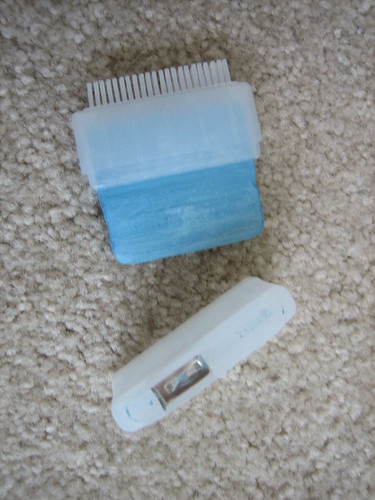
    I have several types of marking items (see the "I want a refund, what a piece of crap" category) but my favorite has always been the basic hunk of chalk, preferably in a holder with a sharpener available. 

    Chalk


    Magnetic pin cushion/wand/nest
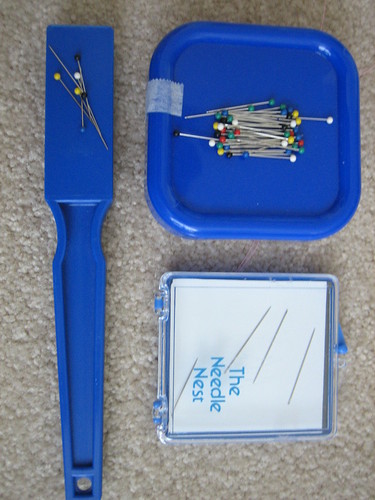
    One can never have enough magnetic gadgets for picking up or holding pins.  The "nest" is the best for traveling and the wand works great for finding pins in the carpet.

    Magnetic pincushions


    Paper medical tape
    This little gem earned me a nod in Threads magazine.  I use it to hold "cording" in place for my corded buttonholes.  I mark seam allowance guides on my machine.  I tape patterns together after altering (or attack from kitty claws).  

    Over-sized cardboard mat
    I use this mat for cutting out patterns, adjusting patterns, laying out fabric, measuring fabric, protecting fabric from rough table edges and as a work surface in general.  It's not a huge investment ($15-25 USD) but I guard it against cat claws and husbands that want to jot a note down and see this surface as a table to lean on.

    Wooden yard stick
    I misplaced it once and had to buy another.  Unfortunately the store I went to only had metal ones.  I dislike metal rulers.  They don't feel right in my hand.  Plastic and wood are more comfortable to work with.  Wood is great because I haven't broken one yet.  The plastic rulers haven't fared so well.

    Cheap ink pen and Sharpie
    Sometimes this is a better marking tool than chalk.  I use those crappy hotel pens to mark patterns and fabrics (in places it won't show).  The cheap pens are also good for writing on muslin when you are recreating a pattern.  I also use Sharpies for marking up muslins during fitting.

    Rowenta steam iron
    Do yourself a favor and invest in a good iron.  I can't afford the fancy steamers but I did upgrade to a nice Rowenta iron (on sale and it came with a rebate at Bed Bath & Beyond).  I used to hate ironing and now I find it almost enjoyable and most definitely easier.

    Seam ripper
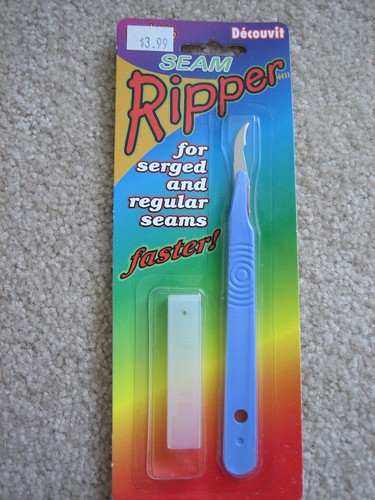
    I have 2 styles that I love.  One is the basic cheap seam ripper that you can buy in any store.  The other is like a scalpel and I have 2 different styles, a curved one designed for ripping seams and the other is supposed to be a buttonhole cutter.  The cheap seam ripper is great when the fabric you are handling is sturdy or you want to pull the thread out as opposed to cut it.  The scalpel seam ripper works well with delicate fabrics, when you need precision control, and I sometimes use it for pulling out threads (I turn it so the dull side can be used).  I also use the buttonhole slicer for cutting/ripping seams and cutting open buttonholes.  In a pinch, I use cheap razor blades for cutting buttonholes as well.

    Seam Ripper


    Accessory feet

    I found a retailer that sold just about every accessory for my sewing machine so I waited for a sale.  I ended up spending over $200 USD just on accessory feet.  With the exception of one, I've used them all and found them very handy.  The ones that get the most use are the edgestitcher, walking foot and the stitch-in-the-ditch feet.  My topstitching has improved by leaps and bounds with the edgestitcher.  I now understand why some people only sewing with a walking foot. Sure you could pin fabrics together to align the ends perfectly...or you can just use the walking foot and stop cursing and stabbing yourself with pointy pins.  I also found an automatic buttonholer for my Singer (the kind that comes with tons of buttonhole plates).  This thing has always worked so much better than any buttonhole function on any machine I've ever owned.

    Beeswax
    The packaging doesn't tell you how to use it and I couldn't understand how it would work (and not damage your needle or fabric).  Then I had a "duh" moment in a sewing class...you need to heat up the wax.  Don't I feel silly.  I hated hand stitching until I finally figured out how to use this stuff.  What a time saver!  In my defense, every packaged beeswax I've ever picked up says nothing about using heat, just to run your thread through it.  I suppose you could use it without heat but I like it iron it.

    #2 Neat tools
    Tailor's ham & Point presser/clapper
    I just bought these last year.  Before that, I used to create really odd contraptions to iron hard-to-reach places.  Besides, "clapper" just sounds funny.

    Buttonhole gauge
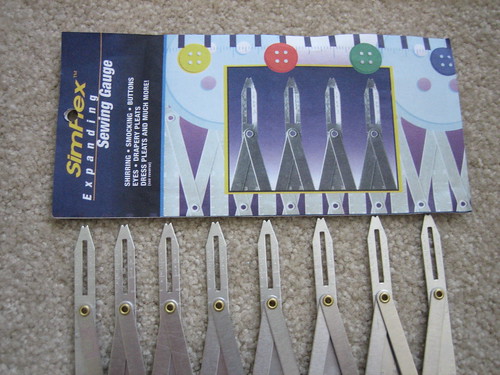
    Looks like an accordion and really isn't a necessary tool but makes life easier when your brain won't do basic math.  Figure out how many buttons you will have, put point one at the first buttonhole and the last point at the last buttonhole...ta-da! Buttonhole spacing is perfectly even every time.  When I took my couture sewing class in Nashville last summer, we went shopping at Textile Fabrics.  I was so excited to shop in a store with nothing but fashion fabrics but when I entered I felt overwhelmed.  I ended up buying this buttonhole gauge, the above-mentioned clapper and buttons for my Nashville Chanel.  Even the salesperson was surprised I didn't buy fabric.  The store was even having a sale on every piece of fabric and still I bought none.  Do you see how overwhelmed I was?!!

    Buttonhole gauge


    Sewing needle pin cushion/storage
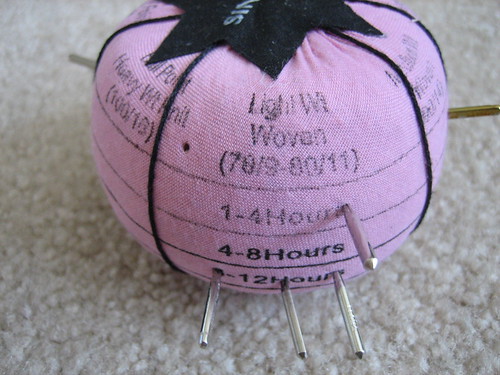
    Everyone has their system for keeping track of what a needle is and how much use its had.  I've never been able to maintain a system.  I found this little gem in JoAnn's and I use it consistently every time.  I'm still not sure how you are supposed to estimate how many hours you have sewn with a particular needle so I probably change them sooner than I need to.

    Pincushion with needle types


    #3 Looked cool, haven't use it yet
    Jean-a-ma-jig
    We all have them.  Do you use yours?  When I get to the seam that could use a boost to stitch over, I just plow on through instead of stopping to find my Jean-a-ma-jig.  I think it's still in the package too.

    Serger foot for conventional sewing machine
    Yes, I know it doesn't make your sewing machine function like a serger but it supposedly stitches and trims at the same time.  Sounded handy but I've never used it.  It was the most expensive accessory foot I bought too.

    #4 Piece of crap
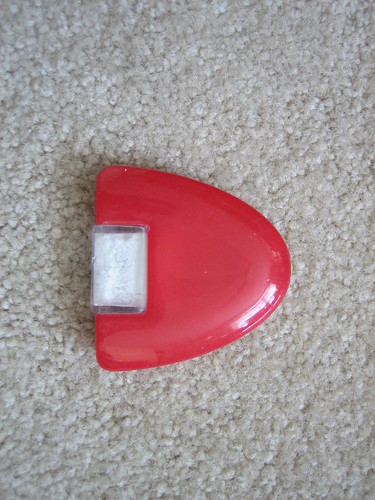
    Chalkoner
    Seriously, how do you make this thing work?  Mine won't work on any fabric.  I even have 2 of them and neither will mark so clearly I'm doing something wrong.  In the meantime, I'm blaming it on the Chalkoner.

    Chalkoner


    Marking Pens
    Disappearing ink, different colored ink, wash-away ink, doesn't matter.  I dislike them all.  They make me nervous (what if the ink doesn't come out?).  I trust chalk.  I can make it disappear every time.  If I mark incorrectly with chalk, I can fix it immediately without waiting for ink to disappear or finding a wet sponge to remove ink.

    Uniquely You dress form
    First, the service sucks.  Doesn't matter who you buy it from because the retailer will have to contact the manufacturer (one-person shop) to send it to you.  He is slow to ship, didn't include every part I needed, and then refused to return my calls or phone calls from the retailer I bought it from.  I finally did receive everything but I think this dress form is already ruined for me.  The cover was a pain to fit so I'm making my own.  I now wish I had saved my money and bought an adjustable Ronis instead.

    Snips
    This is more of a danger to me than a piece of crap.  Everyone said "you must buy snips/snippers, etc.", so I did.  I've cut my fingers (deeply, I might add) on many occasions.  I've decided I simply can't afford to keep replacing fabric I've bled on so my Fiskars snips stay safely in my drawer.

    Just my opinion....

    This policy is valid from 11 December 2009
    This blog is a personal blog written and edited by me. This blog does not accept any form of advertising, sponsorship, or paid insertions. We write for our own purposes. However, we may be influenced by our background, occupation, religion, political affiliation or experience.
    The owner(s) of this blog will never receive compensation in any way from this blog.
    The owner(s) of this blog is not compensated to provide opinion on products, services, websites and various other topics. The views and opinions expressed on this blog are purely the blog owners. If we claim or appear to be experts on a certain topic or product or service area, we will only endorse products or services that we believe, based on our expertise, are worthy of such endorsement. Any product claim, statistic, quote or other representation about a product or service should be verified with the manufacturer or provider.
    This blog does not contain any content which might present a conflict of interest.
    To get your own policy, go to http://www.disclosurepolicy.org